
Featured project · PHM / APM
Rotating Equipment PHM Platform
Physics-guided, regime-aware predictive health management for rotating machinery. Ranked failure mechanisms with the evidence behind them, not a black-box score.
- 6
- failure mechanisms simulated
- 3
- monitoring scopes per pump
- 1.08M
- healthy samples used for training
- 7 / 30 / 90
- day horizons for crossing probability
A physics-guided, regime-aware architecture built on normal-behaviour modelling and evidence fusion is a more defensible industrial starting point than an end-to-end fault classifier.
Four design principles
Physics, not curve-fitting
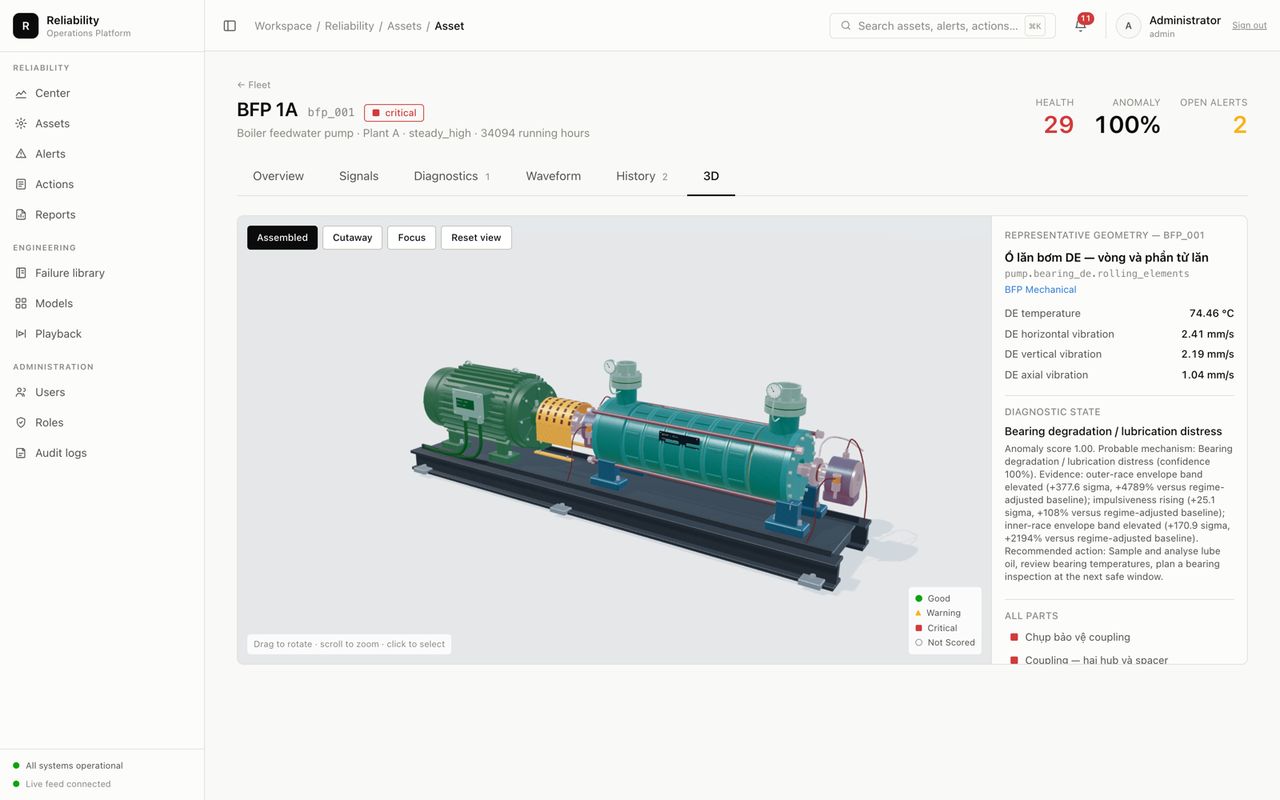
A simulated pump train with a real head curve, BEP efficiency, NPSH margin and shaft power. Six failure mechanisms are injected as causes; the symptoms follow from the hydraulics.
Regime before residual
A run-state machine and load bands decide whether a reading can be scored at all. Start-up, shutdown and load ramps are refused, not scored.
Ranked mechanisms with evidence
An FMEA rule-weight matrix fuses residuals into a ranked list with supporting and contradicting evidence: which variable moved, what the model expected, by how many sigma.
Honest prognostics
A 7, 30 and 90-day crossing probability instead of a point RUL the data cannot support. When the health index has already crossed the threshold, the platform says so.
Product tour
The operator's path from noticing a problem to closing the loop. Every screenshot is the running system.
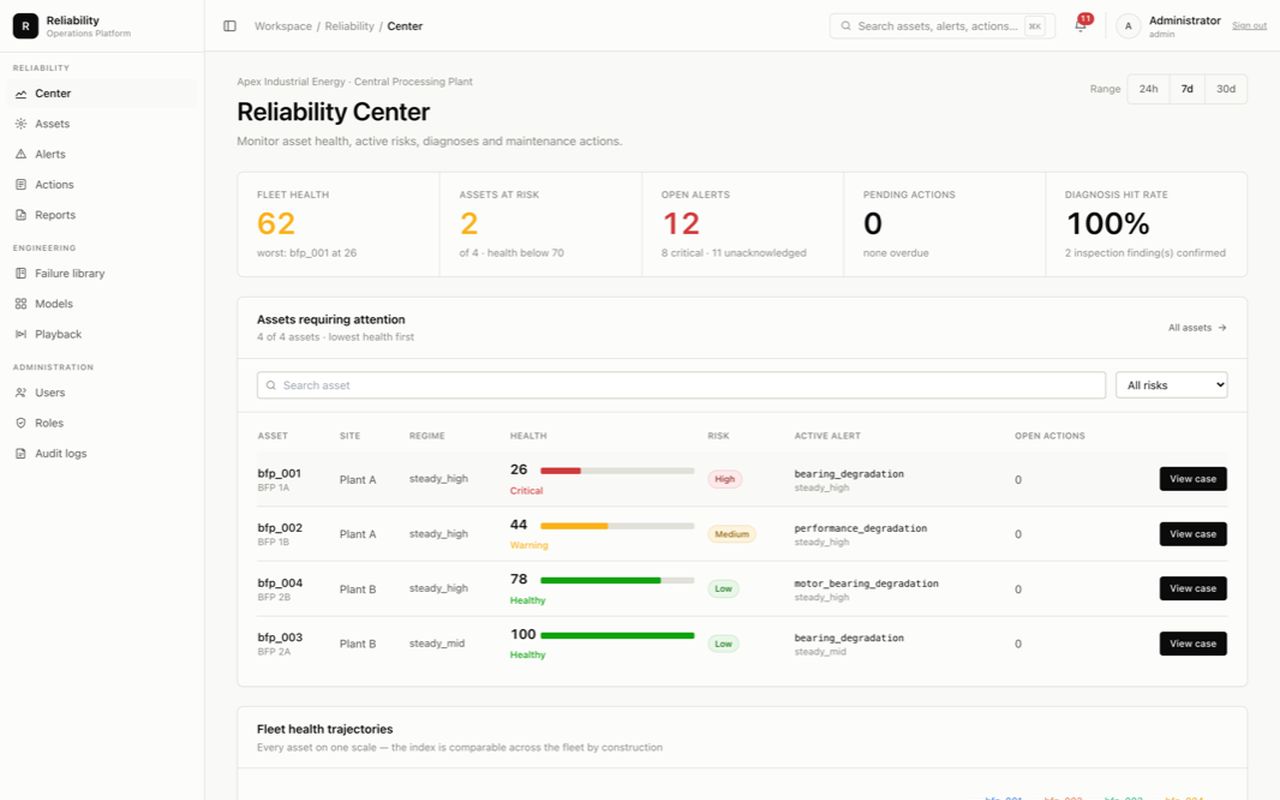
Reliability Center. A KPI strip, a ranked asset table, fleet health trajectories and alert activity: where to look first.
Layered architecture
Each layer is validated separately and degrades independently: if the horizon model is not credible, anomaly detection and diagnosis still work.
Machine physics and FMEA
Pump curve, NPSH, BEP efficiency; 6 failure modes with separable signatures.
Sensing and data quality
A sensor quality flag gates scoring: a bad sensor cannot manufacture a diagnosis.
Operating regime
Run-state machine and load bands; start-up, shutdown and ramps are refused.
Normal behaviour model
An XGBoost regressor per monitored variable per steady regime.
Anomaly score
Mahalanobis distance over standardised residuals, calibrated against the healthy p99.
Evidence fusion
An FMEA rule-weight matrix producing a ranked list of mechanisms per scope.
Health index and prognostics
Weights from FMEA severity; 7/30/90-day crossing probability.
CMMS loop
Alert → evidence → work order → inspection finding → confirmed failure mode.
Technology
Limitations, stated rather than hidden
- The simulator is synthetic: failure signatures are separable by construction, so model scores here are not evidence of plant performance.
- What transfers to a real plant is the architecture, the refusal to score during regime changes and the withheld RUL when the data does not support one.
R&D and solution architecture themes
These are research and solution-design directions, not a list of products deployed for clients.
Protective Coating & External Corrosion
Condition surveys, damage maps, repair priorities and inspection history connected to the asset register.
MRO Master Data & e-Catalog
Noun–modifier rules, duplicate detection, equivalence review and material-data approval workflows.
Operations Helpdesk & AI Portal
Request intake, cited knowledge retrieval, expert handoff and an audit trail.
EAM · APM · Data Platform
Integration of work orders, condition monitoring, risk, HSSE and contextualized data around selected use cases.
Let's talk about reliability, maintenance data and digital asset management.
Vietnam · Thailand